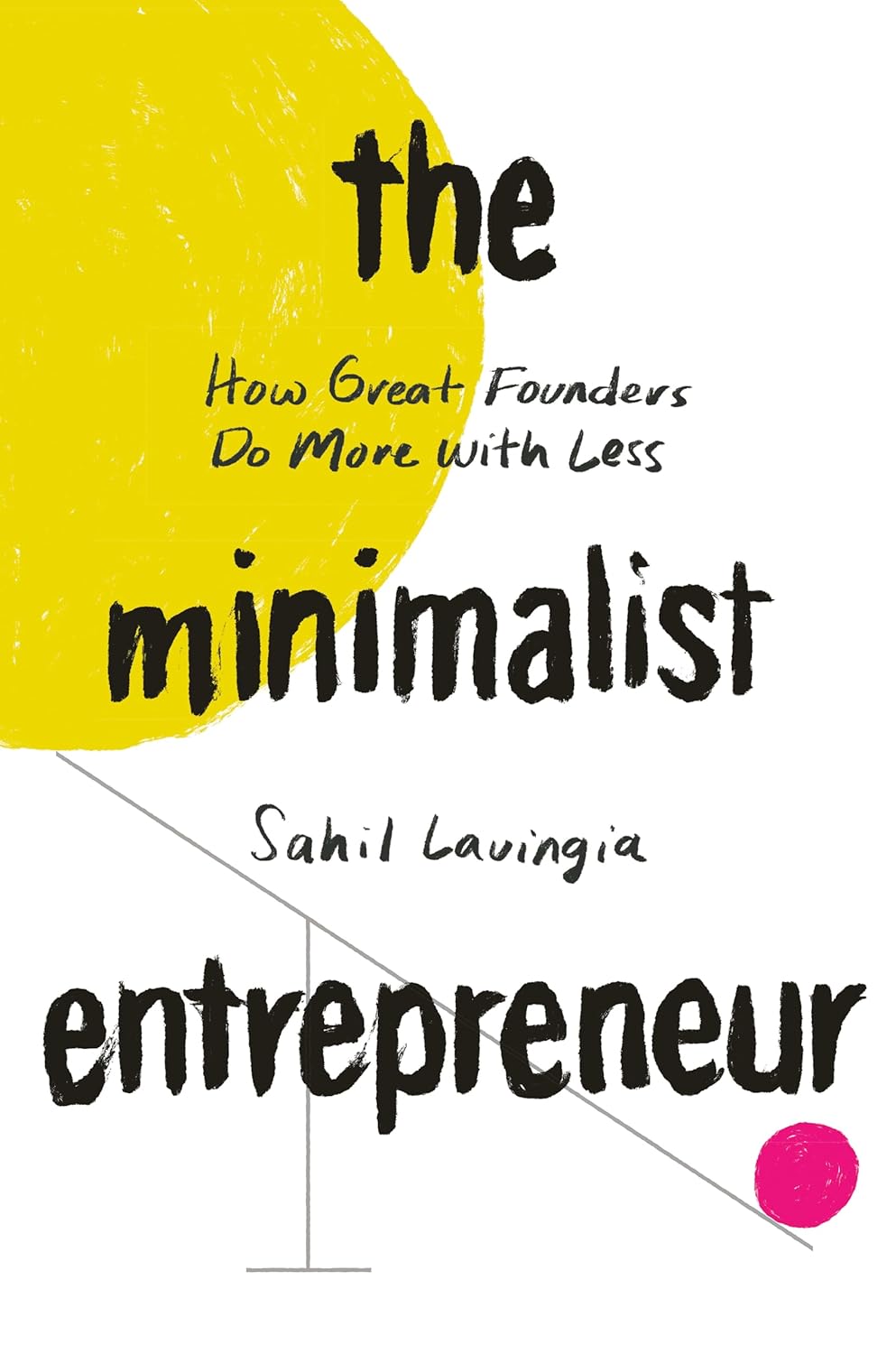
This is not just an entrepreneurship book, it’s a manifesto for building a better world and life via business.
I’ve seen Sahil’s short and blunt tweets before like any other Twitter user interested in startups but I’ve never picked up his book. Now I’ve come to regret that I haven’t read it sooner.
Sahil argues that thinking of business as a soulless money making activity makes our lives miserable. And, there’s an alternative to this.
You become a part of community, solve their problems (also your problems since you are a part of it) and build a meaningful business with your solution.
There is something profoundly beautiful in a value-oriented mission and a genuine purpose driven by your own lived experience. This is what being a minimalist entrepreneur is all about: making a difference while making a living.
Many of us set ourselves for failure by signing up for money-driven careers and lose touch with the value we’re providing for the people around us.
The argument in the book is that you can make a living and make a difference. You don’t have to make a choice, they’re not mutually exclusive.
Start with Community
Before picking a problem to solve, you answer the question of “who?” Whose problems are you going to solve? Who are you serving?
It’s hard to figure out how real a problem is and how important it’s to fix it without having the problem yourself. So we start with ourselves and the people around us.
You can’t be a passive member of that community, you must build real relationships with people and most importantly, you must care. It shows when you don’t.
The community will lead you to your business.
The “Minimal” Part
“Creating a product is a process of discovery, not mere implementation. Technology is applied science,” Naval Ravikant says.
If it’s a process of discovery, you shouldn’t spend months building a well-polished MVP. You must build fast and see the results. If it works, start improving. If it doesn’t, just go back to the previous step.
You also don’t want to sell to thousands of people right from the start. The chances are that your first version won’t be the perfect solution to the problem you’re trying to solve. It’s better to sell to a small group of people first, then listen to what they say and look closely at the ways they’re using your product.
Mindful
Throughout the book, Sahil repeatedly emphasizes on being profitable. Profitability is the only way of sustainability if we’re talking business.
Profit = Revenue – Costs
There are some rules to achieve that:
- Pay yourself as little as possible, at least to start.
- Hire software, not humans.
- Don’t get an office.
- Don’t move to Silicon Valley.
- Outsource everything.
You don’t need to raise capital if your overhead is low. Accepting outside capital adds an unnecessary friction to the business. If you need capital during your growth stage, you can raise money from within your community.
In the old way, the number one downside of raising money was that you created two distinct sets of stakeholders: your investors and your customers. This new practice will allow entrepreneurs to minimize complexity by turning customers into investors. All of a sudden, you have a single group of people you are serving: your community.
Transparency
Transparency makes almost everything easier.
You want to hire someone? You don’t have to spend hours trying to communicate company values to the candidates if it’s already public. Well, most companies have mission and vision statements on their website but let’s be real, how many companies really mean it?
If there’s a Gumroad secret, it’s this one: we aim for complete information symmetry. There’s nothing I know that you don’t, and eventually there’ll be nothing you and I know that our creators don’t.
We are building the best product, with the best team, for the best community. Being open about everything is the flywheel that brings more amazing people into our ecosystem.
It’s hard to maintain that symmetry, but if you’re going to communicate your values to a community, I can’t think of a better way.
It’s a great book that helped me to think of business in a new, down-to-earth way.